
Rain Cyber
SUPERADMIN
Oct 17, 2026
How Businesses Can Combine AI and Human Expertise to Achieve Smarter Growth
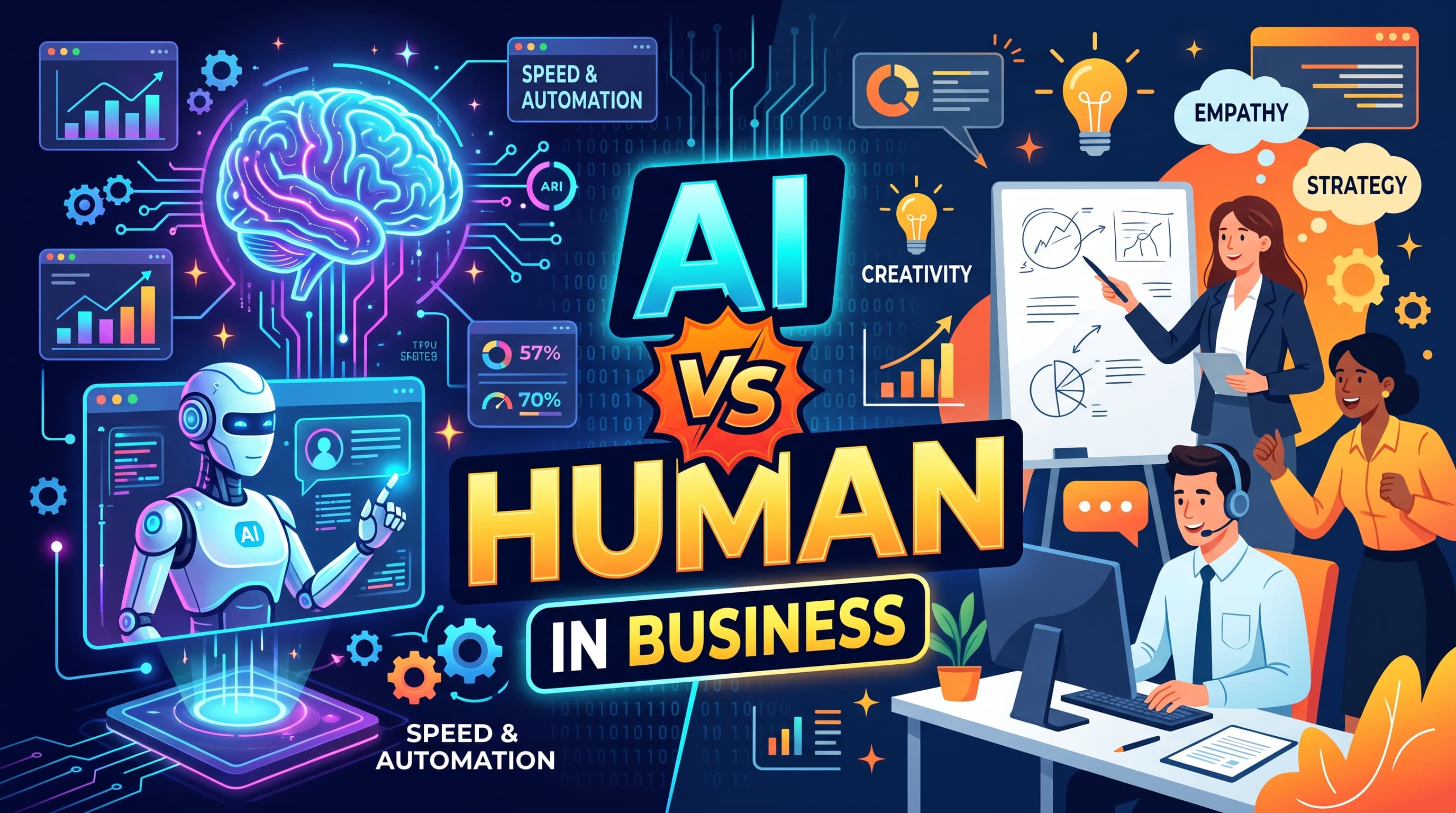
In today's rapidly evolving digital world, businesses are increasingly using Artificial Intelligence (AI) to improve efficiency, automate repetitive tasks, and make data-driven decisions. At the same time, human intelligence remains essential for creativity, strategic thinking, emotional understanding, and building meaningful customer relationships.
But which is better for business—Artificial Intelligence or Human Intelligence?
The answer is not about choosing one over the other. The real opportunity lies in combining the strengths of both to create smarter, more efficient, and more competitive businesses.
At RainCyber, we believe technology delivers its greatest value when it empowers people to work smarter and achieve better results.
What Is Artificial Intelligence in Business?
Artificial Intelligence refers to technologies that enable computers and software systems to perform tasks that typically require human intelligence. These tasks include analyzing information, recognizing patterns, generating content, understanding language, and supporting decision-making.
Businesses across different industries are adopting AI to streamline operations, improve customer experiences, and reduce manual workloads.
Key Benefits of Artificial Intelligence
Automation: Handles repetitive tasks such as data entry, report generation, and routine customer inquiries.
Data Analysis: Processes large datasets to identify trends, patterns, and business opportunities.
Faster Decision Support: Provides insights that help businesses evaluate options more efficiently.
Personalization: Helps businesses tailor recommendations, marketing campaigns, and customer experiences.
Scalability: Supports growing workloads without requiring every task to be handled manually.
For example, an e-commerce business can use AI to analyze purchasing patterns, recommend products, forecast demand, and assist customers through automated chat systems.
However, AI is not perfect. Its results depend on the quality of its data, the way it is implemented, and the quality of human oversight. It can also produce inaccurate information or reflect biases present in its training data.
What Is Human Intelligence in Business?
Human Intelligence involves the ability to reason, learn from experience, understand emotions, think creatively, exercise judgment, and adapt to unfamiliar situations.
While AI can process enormous amounts of information quickly, people bring context, empathy, personal experience, and an understanding of social and ethical considerations.
Key Benefits of Human Intelligence
Creativity and Innovation: Develops original ideas and approaches to complex challenges.
Emotional Intelligence: Understands customer needs, employee concerns, and interpersonal relationships.
Critical Thinking: Evaluates information in context and questions assumptions.
Leadership: Inspires teams, manages change, and builds a positive workplace culture.
Ethical Judgment: Considers human consequences, fairness, accountability, and long-term business values.
For example, AI might identify that customer complaints are increasing. A skilled manager can investigate the underlying causes, understand customer frustrations, and make thoughtful decisions to improve the service.
Human intelligence is equally important when a business faces an unexpected crisis or must make a decision involving competing priorities and values.
Artificial Intelligence vs Human Intelligence: Key Differences
FeatureArtificial IntelligenceHuman IntelligenceProcessing speedProcesses large amounts of data quicklyOften slower with large datasetsData analysisExcellent at finding patterns in available dataInterprets patterns using context and experienceCreativityGenerates ideas based on learned patternsCreates ideas through experience, imagination, and original thinkingEmotional understandingCan recognize emotional signals but lacks human feelingsExperiences emotions and can build genuine personal connectionsDecision-makingSupports decisions using data and defined objectivesConsiders context, values, consequences, and judgmentRepetitive tasksEfficient at automating routine processesCan become fatigued by repetitive workAdaptabilityDepends on its design, training, and toolsCan adapt through experience and flexible reasoningAccountabilityRequires human governance and oversightPeople can take responsibility for business decisions
Both have strengths and limitations. The best choice depends on the task, the business objective, and the risks involved.
How AI and Human Intelligence Work Together
Instead of treating AI and human intelligence as competitors, businesses should view them as complementary capabilities.
Here are five ways organizations can combine them effectively.
1. Smarter Business Decision-Making
AI can analyze sales figures, customer behavior, market trends, and operational data to identify patterns that may otherwise go unnoticed.
Human decision-makers can then evaluate those insights against business goals, practical constraints, and customer expectations.
Example: An AI system forecasts declining sales in a particular product category. A business manager investigates customer feedback and seasonal trends before deciding whether to adjust pricing, inventory, or marketing.
The result is a more informed decision supported by both data and experience.
2. Better Customer Service
AI-powered chatbots and virtual assistants can answer frequently asked questions, provide basic product information, and support customers outside regular business hours.
Human support teams can focus on complex complaints, sensitive situations, and customer problems that require empathy or flexible judgment.
Example: A retail business uses an AI assistant to answer common questions about order status and product availability. Human employees handle refunds, unusual requests, and difficult customer interactions.
This approach can improve response times without sacrificing the personal touch.
3. More Effective Marketing
AI tools can analyze campaign performance, segment audiences, identify customer preferences, and help marketers generate content ideas.
Human marketers contribute brand knowledge, cultural understanding, storytelling, and creative direction.
Example: AI identifies which customer segments respond best to a promotional campaign. The marketing team uses these insights to develop relevant messages that reflect the brand's identity and customers' needs.
Human review remains important to ensure that marketing content is accurate, appropriate, and consistent with the brand.
4. Improved Productivity and Workflow Automation
Many businesses spend valuable time on repetitive administrative work, including preparing reports, organizing records, scheduling tasks, and processing routine requests.
AI and automation tools can reduce this workload, allowing employees to concentrate on problem-solving, planning, and higher-value activities.
Example: A company automates routine sales reporting. Instead of manually compiling spreadsheets, employees can review the results, identify opportunities, and develop strategies to improve performance.
The goal should not simply be to automate everything. Businesses should identify where automation genuinely improves efficiency, accuracy, or service quality.
5. Stronger Innovation and Problem-Solving
AI can help teams explore ideas, summarize research, compare alternatives, and build early prototypes. Human experts can challenge assumptions, identify practical limitations, and determine which ideas are worth pursuing.
Example: A software development team uses AI to assist with code generation and testing. Developers review the code, validate security, understand the business requirements, and make the final technical decisions.
Combining machine-assisted speed with human expertise can support innovation while maintaining quality and accountability.
Challenges of Using AI in Business
Although AI offers significant opportunities, successful adoption requires careful planning.
Data Privacy and Security
AI systems may process sensitive business information and customer data. Organizations should establish appropriate access controls, security measures, and data-handling policies.
Accuracy and Reliability
AI-generated answers and recommendations can be incorrect. Important outputs should be verified, especially when they affect finances, customers, security, or business operations.
Skills and Training
Employees need the knowledge to use AI tools effectively. Training helps teams understand both the capabilities and limitations of these systems.
Implementation Costs
AI adoption can involve software subscriptions, infrastructure, integration, employee training, and ongoing maintenance. Businesses should evaluate expected benefits against the total cost of implementation.
Overdependence on Automation
Relying entirely on AI can reduce human oversight and make organizations vulnerable to errors. Clear responsibilities and human review processes are essential.
How to Implement AI Successfully in Your Business
Businesses do not need to transform every process at once. A practical, step-by-step approach can make adoption more manageable.
Step 1: Identify Business Challenges
Determine which activities consume too much time, create recurring errors, or prevent employees from focusing on important work.
Step 2: Choose the Right AI Tools
Select solutions that address specific needs, such as data analytics, customer support, workflow automation, or software development.
Step 3: Start with a Small Project
Test AI in a limited area before expanding its use across the organization. A pilot project helps reveal practical benefits and potential risks.
Step 4: Keep People Involved
Assign responsibility for reviewing AI outputs, handling exceptions, and making decisions that require human judgment.
Step 5: Measure the Results
Evaluate improvements using relevant indicators, such as processing time, error rates, customer satisfaction, employee productivity, and operating costs.
Step 6: Improve Continuously
Review performance regularly, update processes, train employees, and adjust the implementation as business requirements evolve.
The Future of AI and Human Intelligence in Business
The future of business will increasingly depend on collaboration between intelligent technologies and skilled people.
AI is expected to continue advancing in areas such as predictive analytics, personalized services, software development, workflow automation, and decision support. Meanwhile, human capabilities such as leadership, empathy, creativity, communication, and strategic thinking will remain critical to successful organizations.
Businesses that prepare their employees to work alongside AI may be better positioned to adapt to changing customer expectations and competitive pressures.
The most effective organizations will not necessarily be those that use the most AI. They will be those that use technology purposefully, protect their data, develop their people, and maintain clear accountability for decisions.
Conclusion: The Winning Strategy Is AI + Human Intelligence
Artificial Intelligence and Human Intelligence each bring valuable strengths to business. AI excels at processing information, identifying patterns, and automating repetitive tasks. People contribute creativity, emotional understanding, contextual judgment, leadership, and accountability.
Together, these capabilities can help businesses improve productivity, deliver better customer experiences, and make more informed decisions.
For organizations planning their digital transformation, the priority should be finding the right balance between automation and human expertise.
RainCyber helps businesses explore technology solutions that support smarter operations, stronger digital capabilities, and sustainable growth.
Ready to make your business more efficient with the right technology?
Partner with RainCyber to explore IT solutions tailored to your business needs.
🌐 Website: https://raincyber.com
📩 Contact RainCyber today to discuss your digital transformation goals.
#RainCyber #ArtificialIntelligence #HumanIntelligence #BusinessAutomation #DigitalTransformation #AIinBusiness #BusinessGrowth #TechnologySolutions